

Civil Rights & Police Misconduct
Wisconsin Malicious Prosecution Lawyers
Being Prosecuted Without Probable Cause Can Be a Civil Rights Violation
Being Prosecuted Without Probable Cause Can Be a Civil Rights Violation
Malicious prosecution occurs when someone — often a police officer — initiates or continues criminal proceedings against you without probable cause and for an improper purpose, and the case ultimately ends in your favor. A baseless prosecution can cost you your freedom, your job, your savings, and your reputation, even if the charges are eventually dropped or you are acquitted. The U.S. Supreme Court confirmed in Thompson v. Clark that you can bring a Fourth Amendment malicious prosecution claim under 42 U.S.C. § 1983 without having to prove your innocence — only that the prosecution ended without a conviction.
Strang Bradley holds accountable the officers and officials who manufacture charges, fabricate evidence, or pursue prosecutions they know are baseless.
Elements of a Malicious Prosecution Claim
To succeed on a federal malicious prosecution claim, you generally must show:
- Criminal proceedings were initiated or continued against you
- Without probable cause
- For a purpose other than bringing you to justice (an improper motive)
- You were seized or deprived of liberty as a result (for example, arrested, jailed, or subjected to bond conditions)
- The proceedings terminated in your favor (dismissed, dropped, or acquitted)
Common Examples of Malicious Prosecution
- Officers fabricating or planting evidence to support charges
- Falsifying police reports or affidavits to establish probable cause
- Withholding exculpatory evidence from prosecutors (Brady material)
- Coercing or scripting false witness statements
- Pursuing charges in retaliation for protected activity or out of personal bias
- Continuing a prosecution after exculpatory evidence has clearly emerged
What to Do If You Believe You Were Maliciously Prosecuted
- Preserve every document from your criminal case — charging documents, police reports, court records, and the order or notice showing how the case ended in your favor.
- Write down the timeline of events, including what you believe the officers’ true motive was.
- Keep records of the costs you incurred: bail, lost wages, attorney’s fees, and the emotional toll.
- Contact a civil rights attorney promptly — the favorable termination of your criminal case may start the clock on your civil claim.
Constitutional and Wisconsin Law
Federal malicious prosecution claims proceed under the Fourth Amendment through 42 U.S.C. § 1983, following Thompson v. Clark. Wisconsin also recognizes a state common-law tort of malicious prosecution. Prosecutors enjoy absolute immunity for their advocacy in court, but that immunity generally does not protect investigative misconduct such as fabricating evidence, and officers can be held liable for the role they played in launching a baseless case. A municipality may face Monell liability where such conduct reflects a policy or pattern.
Compensation You May Be Entitled To From A Malicious Prosecution
- Time spent in custody or under bond conditions
- Lost wages and lost earning capacity
- Criminal defense fees and costs you paid
- Emotional distress and reputational harm
- Compensation for the constitutional violation itself
- Punitive damages against individual officers in egregious cases
- Attorney’s fees under 42 U.S.C. § 1988
Why Choose Strang Bradley for a Malicious Prosecution Case
Because we also practice criminal defense, few firms understand the machinery of a criminal case the way ours does. That insight lets us reconstruct exactly how a prosecution was built, identify where officers crossed the line from investigation into fabrication, and prove the absence of probable cause to a civil jury. We have spent our careers at the intersection of criminal defense and civil rights.
In the news
-
 55 Swatting Calls: A Couple’s Fight Against Online Stalkers and the Police
The city of Milwaukee agreed to a $575,000 settlement after months of heavily armed police responses to 911 calls to the couple’s home that officials knew were hoaxes.
John Bradley, a lawyer for the couple, acknowledged that the Milwaukee police “did their job on the first few swatting calls.”
“The problem,” he added, “came after it had happened dozens of times.”
55 Swatting Calls: A Couple’s Fight Against Online Stalkers and the Police
The city of Milwaukee agreed to a $575,000 settlement after months of heavily armed police responses to 911 calls to the couple’s home that officials knew were hoaxes.
John Bradley, a lawyer for the couple, acknowledged that the Milwaukee police “did their job on the first few swatting calls.”
“The problem,” he added, “came after it had happened dozens of times.”
-
 Wisconsin police chief sued 3x, accused of unconstitutional stops
A sheriff’s deputy and small-town police chief, Brendan Cutrell, is the subject of three federal lawsuits alleging he violated the Fourth Amendment rights of individuals he pulled over.
Wisconsin police chief sued 3x, accused of unconstitutional stops
A sheriff’s deputy and small-town police chief, Brendan Cutrell, is the subject of three federal lawsuits alleging he violated the Fourth Amendment rights of individuals he pulled over.
-
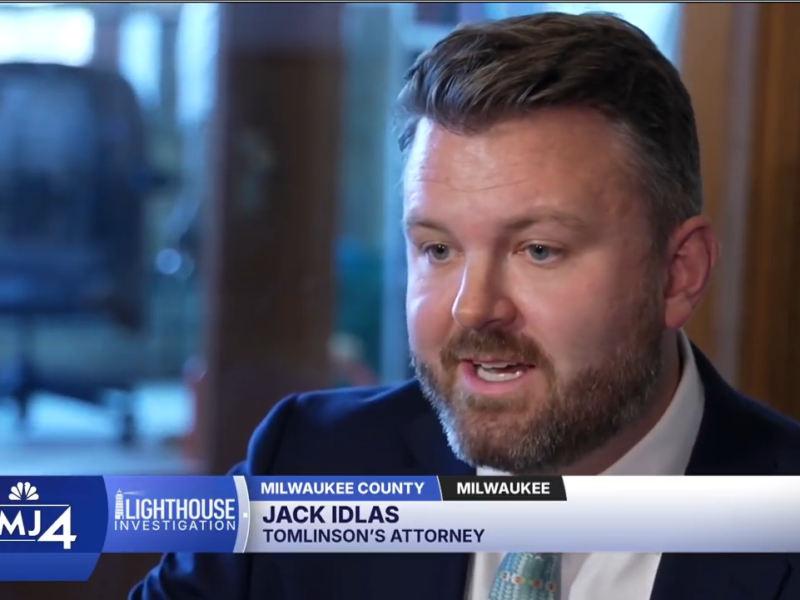 TMJ4 Lighthouse Investigation – City of Milwaukee Settles $575,000 Swatting Lawsuit
TMJ4's Investigative Report about the City of Milwaukee Settling a Civil Rights Lawsuit by Niki Robinson and Patrick Tomlinson for $575,000 For MPD's Relentless Swatting of Their Home.
TMJ4 Lighthouse Investigation – City of Milwaukee Settles $575,000 Swatting Lawsuit
TMJ4's Investigative Report about the City of Milwaukee Settling a Civil Rights Lawsuit by Niki Robinson and Patrick Tomlinson for $575,000 For MPD's Relentless Swatting of Their Home.
-
 Milwaukee couple reaches $575,000 settlement with city after repeated swatting responses
After years of harassment, frustration, and danger, a Milwaukee couple is poised to receive a settlement payment from the City of Milwaukee. The city has agreed to pay the $575,000 settlement for not properly training 20 officers involved.
Milwaukee couple reaches $575,000 settlement with city after repeated swatting responses
After years of harassment, frustration, and danger, a Milwaukee couple is poised to receive a settlement payment from the City of Milwaukee. The city has agreed to pay the $575,000 settlement for not properly training 20 officers involved.
-
 City may pay $575,000 to settle MPD ‘swatting’ lawsuit involving local author
Milwaukee City Attorney Evan Goyke is recommending that the city pay more than half a million dollars to settle a federal lawsuit over the Milwaukee Police Department repeatedly entering and searching a local author’s home in response to false 911 calls.
City may pay $575,000 to settle MPD ‘swatting’ lawsuit involving local author
Milwaukee City Attorney Evan Goyke is recommending that the city pay more than half a million dollars to settle a federal lawsuit over the Milwaukee Police Department repeatedly entering and searching a local author’s home in response to false 911 calls.
-
 Strang Bradley defends Wisconsin man on federal charges after posting TikTok videos
CNN has reached out to Stanton’s attorney for comment.
In a statement to the New York Times, John Bradley, a lawyer for Stanton, said: “It is important to remember that the contents of a criminal complaint represent one side of the story and are just allegations. Mr. Stanton pled not guilty. He is presumed innocent, and we will vigorously defend against these charges in court.”
Strang Bradley defends Wisconsin man on federal charges after posting TikTok videos
CNN has reached out to Stanton’s attorney for comment.
In a statement to the New York Times, John Bradley, a lawyer for Stanton, said: “It is important to remember that the contents of a criminal complaint represent one side of the story and are just allegations. Mr. Stanton pled not guilty. He is presumed innocent, and we will vigorously defend against these charges in court.”
-
Strang Bradley defends Wisconsin man facing federal charges related to ICE agents
In a statement, John Bradley, a lawyer for Mr. Stanton, a Marine Corps veteran who served in the Iraq War, said: “It is important to remember that the contents of a criminal complaint represent one side of the story and are just allegations. Mr. Stanton pled not guilty. He is presumed innocent, and we will vigorously defend against these charges in court.”
-
 County, city, several officers named in civil rights lawsuit
A Rhinelander man has filed a federal lawsuit in the United States District Court for the Western District of Wisconsin, alleging seven Oneida County sheriff’s deputies and two city police officers violated his civil rights by engaging in an illegal search and seizure, unreasonable extension of seizure, unlawful arrest and failure to intervene.
County, city, several officers named in civil rights lawsuit
A Rhinelander man has filed a federal lawsuit in the United States District Court for the Western District of Wisconsin, alleging seven Oneida County sheriff’s deputies and two city police officers violated his civil rights by engaging in an illegal search and seizure, unreasonable extension of seizure, unlawful arrest and failure to intervene.
-
Shorewood woman receives $760K civil rights settlement from City of Milwaukee
Stephanie Rapkin has been awarded a $760,000 settlement after suing Shorewood and Whitefish Bay over her arrest in 2020 where police conducted a search of her home without a warrant. “To our knowledge, this is the largest police misconduct civil rights settlement in Wisconsin that doesn’t involve a death or serious injury,” John Bradley, one of Rapkin’s attorneys, told the Journal Sentinel.
Our Team
Strang Bradley’s Civil Rights Lawyers


Answers
Malicious Prosecution FAQs
-
Do I have to prove I was innocent?
No. After Thompson v. Clark (2022), you only need to show the criminal case ended without a conviction — not affirmatively prove your innocence — along with the other elements like lack of probable cause.
-
Can I sue the prosecutor?
Usually not for their in-court advocacy, which is protected by absolute immunity. But officers — and prosecutors acting as investigators — can be liable for fabricating evidence or manufacturing probable cause.
-
My charges were dismissed. Do I have a case?
A favorable termination is one key element. Whether you have a claim also depends on showing the prosecution lacked probable cause and was driven by an improper purpose. We can evaluate that for you.
Were you wrongfully prosecuted? Let’s talk.
Consultations are free and confidential. Tell us what happened and we will tell you how we can help.